
Places > Florence
Santa Croce Monumental Complex
Florence, piazza di Santa Croce 16
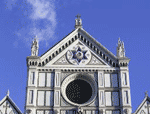
The
church of Santa Croce was built starting in 1295 on the site of an existing
Franciscan church. The spiritual, social, productive and cultural life of the
entire quarter was organized around this religious center. The church became an
extraordinary forge of talent where such artists as Giotto, Donatello and
Brunelleschi worked. The presence of funerary monuments of illustrious
personages, among them a number of scientists, makes Santa Croce the "pantheon
of the Italians", celebrated by Ugo Foscolo in the Sepolcri.
After
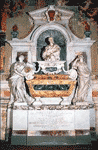
the death of Galileo Galilei (1642) his remains were placed in a little room
below the bell tower of the church of Santa Croce, next to the Chapel of Saints
Cosmos and Damian, while awaiting the building of a monumental tomb. This
project, however, was opposed by the ecclesiastical authorities, who advised
Grand Duke Ferdinando II de' Medici that it was unsuitable to erect a monument
to a man convicted by the Church. In
In
the Basilica are also to be found the tombs of Fossombroni (a decisive figure
in the complex work of draining the swamps of Maremma implemented by Leopoldo
II), of Eugenio Barsanti, the inventor, in collaboration with Father Felice
Matteucci, of the first prototype of internal combustion engine (an engine that
utilized the internal combustion of gases to produce motive force) and the
physicist Leopoldo Nobili.
The
Santa Croce monumental complex is a place of significance for science also for
the astronomical fresco in the Pazzi Chapel, designed by Brunelleschi,
representing a nocturnal sky, similar to the one in the Old Sacristy of San
Lorenzo.